
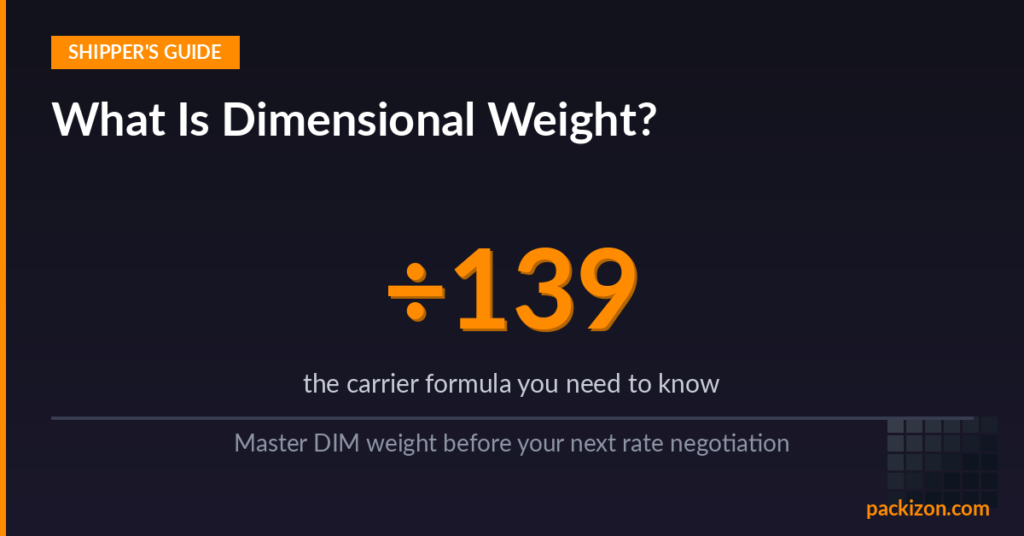
Dimensional Weight vs Actual Weight: What’s the Difference?
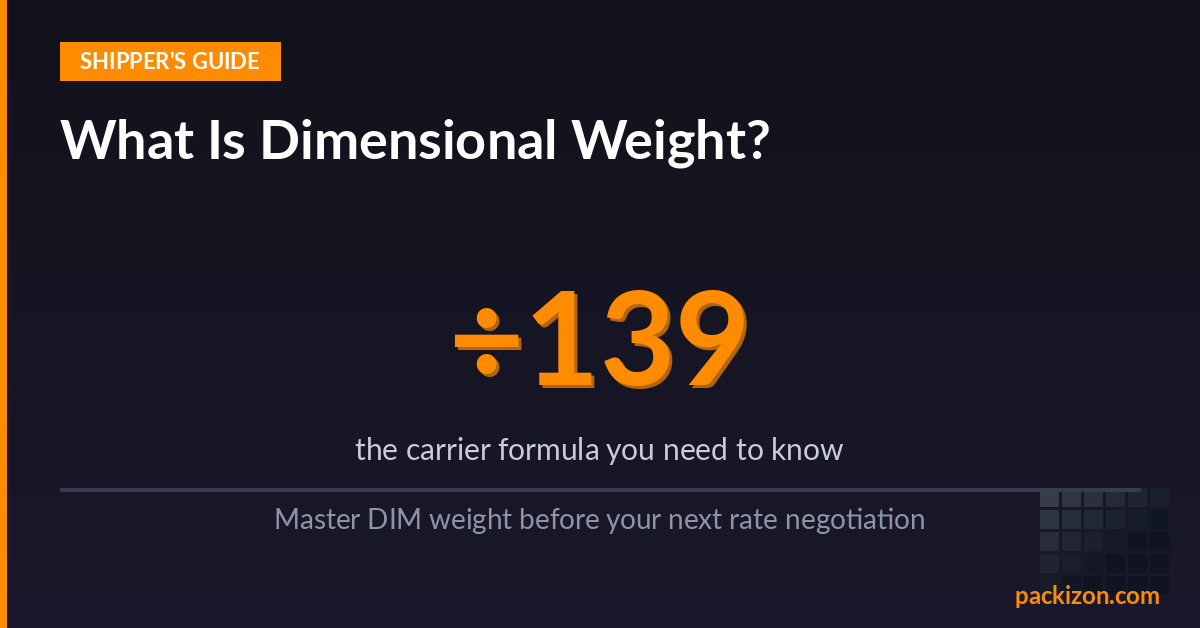
Quick Answer: Dimensional weight (DIM weight) is a calculated shipping weight based on package volume, used when it exceeds actual weight. Actual weight is what the scale reads. Carriers (UPS, FedEx, USPS) bill whichever is higher. A 12×12×12-inch box weighing 3 lbs has a DIM weight of 12.4 lbs — so you’d be billed nearly 4× the actual weight.
The Difference Between Dimensional Weight and Actual Weight
Every package you ship has two weights: the actual weight registered on a scale, and the dimensional weight calculated from its size. Carriers charge you whichever is higher. Actual weight is straightforward — it is the physical mass of the box and its contents in pounds or kilograms. Dimensional weight is a calculated figure that converts the package’s cubic volume into an equivalent weight, using the formula: (Length × Width × Height) ÷ DIM divisor.
For FedEx and UPS domestic shipments, the DIM divisor is 139 (in inches). A lightweight product in a large box — a foam cushion, a garment, or a loose-fill item — may weigh only 2 lbs on the scale but calculate to 15 lbs or more in DIM weight. The carrier will bill 15 lbs regardless of what the scale says.
A Brief History: When DIM Weight Pricing Became Universal
DIM weight pricing for large parcels has existed since the 1980s, initially limited to air freight and oversized packages. The industry shift came in 2015, when FedEx and UPS simultaneously expanded DIM weight pricing to cover all parcel sizes — including small packages previously exempt from the formula. UPS followed within the same rate cycle. USPS extended DIM pricing to Priority Mail and Priority Mail Express packages over one cubic foot shortly after.
The change was driven by the rise of e-commerce and the economics of parcel delivery. Carriers operate on space, not just mass: a truck or aircraft can only hold a fixed volume, and lightweight oversized packages were consuming space without generating revenue proportional to their footprint. DIM weight pricing corrected this by ensuring shippers pay for the space their packages occupy, not just their weight.
How to Tell Which Weight You Are Being Charged For
UPS and FedEx invoices show both the billed weight and the DIM weight for each shipment. If the DIM weight is listed as the billed weight, you are being charged on dimensions rather than the scale. Most carrier-connected shipping software — ShipStation, EasyPost, Shippo — also show both figures at the time of label creation, so you can see immediately how a package will be rated before it ships.
Reviewing your carrier invoices at the SKU or packaging level reveals which products are generating the highest ratio of DIM weight to actual weight. These are the candidates for carton optimisation: smaller boxes, better fill materials, or polymailer alternatives where the product type permits. Even reducing a single dimension by two inches can meaningfully change the DIM weight calculation for a high-velocity SKU.
Three Strategies to Reduce Dimensional Weight Charges
The most direct approach is right-sizing your cartons. A box two inches smaller in each dimension reduces cubic volume by roughly 30%, which can flip the billing basis from DIM weight to actual weight for many SKUs. Cartonisation software can automate the selection of the optimal box size for each order, but it requires accurate item master dimensions as inputs — which in turn requires reliable measurement of every SKU.
A second strategy is negotiating a higher DIM divisor with your carrier. Standard divisors are 139, but high-volume shippers can negotiate custom divisors of 166 or higher, effectively reducing the DIM weight calculated for the same physical package. Carriers require certified measurement data — from NTEP-approved equipment — to evaluate negotiation proposals.
Third, use automated dimensioning to eliminate the measurement gap between what you think your packages measure and what the carrier’s re-weigh system finds. Carrier billing adjustments (chargebacks) arise when their measurement differs from yours at time of shipment. The Packizon Dim L1 captures certified dimensions at the point of packing, ensuring your declared DIM weight matches the actual package before it ever reaches a carrier hub.
Which Shipping Services Are Exempt From DIM Weight?
Not all carrier services apply DIM weight pricing. USPS Ground Advantage and First-Class Package Service do not use DIM weight — packages are billed on actual weight only. USPS Priority Mail applies DIM weight only to packages exceeding one cubic foot (1,728 cubic inches), using a divisor of 166. FedEx and UPS apply DIM weight to all domestic parcel shipments regardless of size.
Regional carriers — OnTrac, LaserShip, LSO — have varying policies, and some apply DIM weight thresholds similar to USPS rather than the universal FedEx/UPS model. If your carrier mix includes regional partners, confirm their specific DIM weight rules in your rate agreement, as they can differ significantly from national carrier defaults.
Frequently Asked Questions
What is the difference between dimensional weight and actual weight?
Actual weight is the physical weight of the package as measured on a scale, in pounds or kilograms. Dimensional weight is a calculated weight based on the package’s volume: (L × W × H) ÷ DIM divisor. Carriers charge whichever is greater. This means a large but light box — like one containing a pillow or inflatable item — can cost far more to ship than its actual weight suggests.
When did dimensional weight pricing start?
FedEx introduced dimensional weight pricing for all parcel sizes in 2015. UPS followed within the same year. Before 2015, DIM weight only applied to packages over 3 cubic feet. The 2015 change meant that even small, light packages could be billed on DIM weight — dramatically increasing shipping costs for e-commerce sellers with bulky, lightweight products.
How do I know if I’m being charged DIM weight or actual weight?
Check your carrier invoice line items. UPS and FedEx show both ‘Billed Weight’ and ‘DIM Weight’ on detailed invoices. If billed weight exceeds your scale weight, you’re being charged DIM weight. You can also calculate it yourself: (L × W × H) ÷ 139. If the result is higher than your scale weight, DIM weight applies.
How can I reduce dimensional weight charges?
Three main strategies: (1) right-size your cartons — a box 2 inches smaller in each dimension reduces DIM weight by 25–40%; (2) deploy a dimensioning system to measure every packed parcel and catch oversized carton selection before shipment; (3) use flat-rate packaging for dense or heavy items. Combining all three typically reduces DIM weight billing by 15–25%.
Does dimensional weight apply to all shipping services?
No. USPS Ground Advantage and First Class Package Service do not use DIM weight. USPS Priority Mail only applies DIM weight to packages over 1 cubic foot. UPS and FedEx apply DIM weight to all domestic packages. DHL and other international carriers use dimensional weight on all services. Always check your specific carrier’s published DIM weight policy.
Industry Data
Dimensional Weight vs Actual Weight: Industry Data
139
DIM divisor used by FedEx and UPS to convert cubic inches to billed weight
166
USPS Priority Mail DIM divisor â higher divisor means lower DIM charges
3-7%
of freight spend overpaid annually due to DIM weight calculation errors
94%
reduction in carrier billing corrections with certified dimensioning systems
<1 sec
time for automated systems to calculate and compare DIM vs actual weight per package