
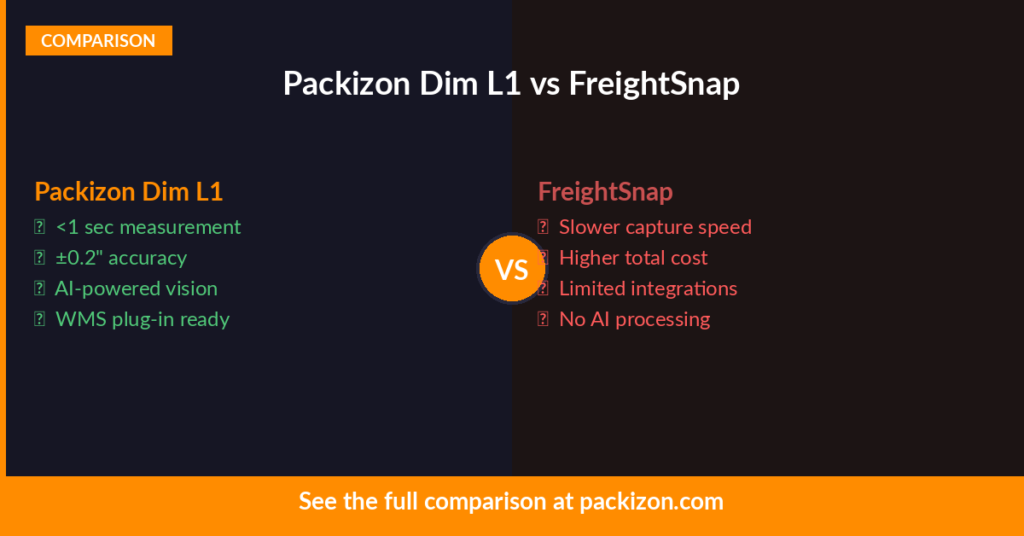
Packizon Dim L1 vs FreightSnap: Which Is Right for Your Warehouse?
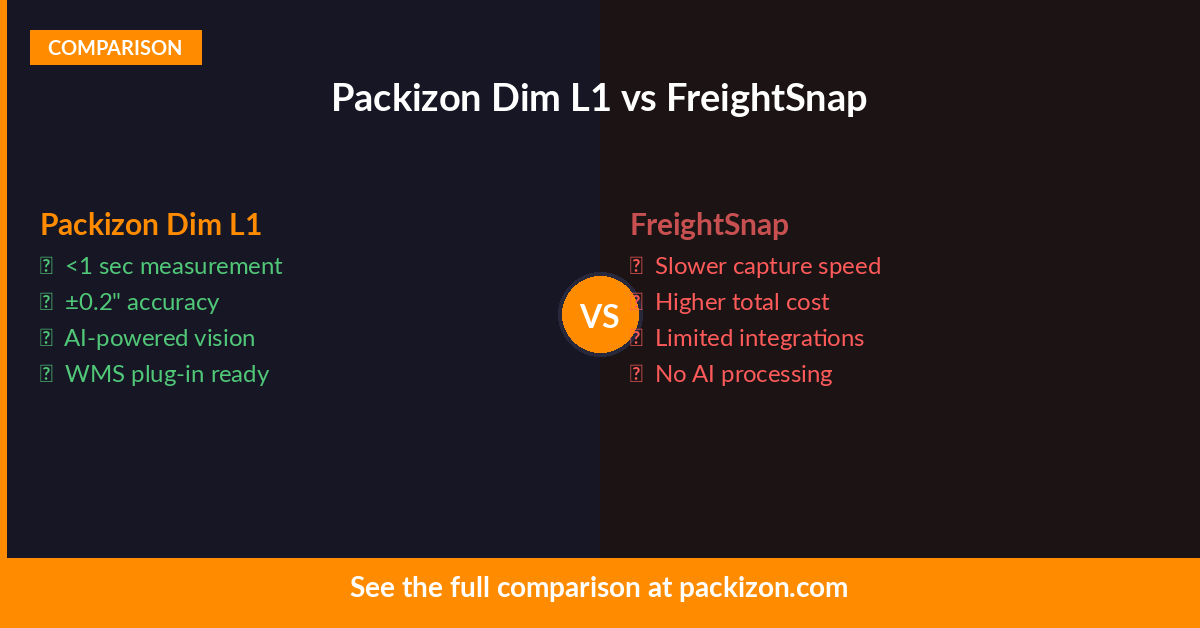
Quick Answer: Packizon Dim L1 and FreightSnap FS-5000 are both dimensioning systems. FreightSnap uses fixed laser frames optimised for LTL pallet-level measurement at $8,000–$15,000. Packizon Dim L1 uses AI computer vision for parcel-level dimensioning at a lower price point, with greater flexibility for packing-station deployment and polybag handling.
Packizon Dim L1 vs FreightSnap: Choosing the Right Dimensioner for Your Operation
FreightSnap builds dimensioning systems primarily for freight and LTL environments — pallet dimensioners and conveyor-integrated systems for high-throughput sortation at freight carriers and large distribution centres. Packizon Dim L1 is designed for parcel-level dimensioning at packing stations and receiving docks, with a focus on self-service deployment, broad package type compatibility, and direct integration with WMS and shipping platforms. The two products address overlapping but distinct operational needs.
If your primary need is pallet dimensioning for LTL freight class assignment, FreightSnap’s pallet systems are purpose-built for that application. If your need is parcel-level dimensioning for carrier rate calculation, item master data capture, or chargeback defence at the packing station, Packizon Dim L1 is the more appropriate solution. For operations with both needs, the two systems are complementary rather than competitive.
Key Differences in Package Type Coverage
FreightSnap’s parcel systems use laser-based measurement and perform well on rigid cartons. Like most laser-array systems, they are less reliable on polybags, flexible packaging, and irregular shapes that don’t present clean edges to the sensor. Packizon Dim L1’s structured-light approach handles the full range of package types found in e-commerce fulfilment — including polybags, mailers, tubes, and irregular industrial items — without requiring a manual measurement exception process for non-standard packages.
For operations with a diverse product mix that includes significant proportions of non-rigid packaging, this capability difference matters directly to automation coverage. A system that auto-measures 85% of packages and requires manual handling for 15% delivers less than 85% of the labour and error-rate benefit of full automation — the exception category carries a disproportionate share of measurement risk.
Deployment Model: Self-Service vs Vendor Installation
FreightSnap’s conveyor-integrated systems require vendor installation, structural modifications for conveyor integration, and professional commissioning. For single-site, high-volume deployments where the conveyor infrastructure already exists, this model is appropriate. For multi-site deployments, rapid rollouts, or operations that want to maintain and reconfigure their measurement setup without vendor dependence, the installation model becomes a constraint.
Packizon Dim L1 deploys self-service in a single day per site. No conveyor modification, no vendor technician visit, no multi-day commissioning. This makes it practical to deploy at multiple sites on the same week, or to reconfigure the measurement position as workflow changes. For operations with seasonal volume peaks that require rapid capacity changes, the deployment flexibility of a self-service system has operational value beyond the initial installation comparison.
Integration and Data Output Comparison
Both systems output dimension data via API. Packizon Dim L1 provides pre-built connectors for major WMS and shipping platforms including Extensiv, ShipStation, EasyPost, and the major carrier APIs, reducing the integration effort required for most deployments. The REST API with JSON output is compatible with any modern platform that can consume API data.
FreightSnap’s data output options vary by system and configuration. For LTL freight environments where FreightSnap is strongest, integration typically targets freight management systems and carrier EDI feeds rather than e-commerce WMS platforms. Operations running e-commerce fulfilment workflows should confirm specific WMS integration compatibility before evaluating FreightSnap for parcel-level dimensioning use cases.
Frequently Asked Questions
What is the main difference between Packizon and FreightSnap?
FreightSnap FS-5000 is designed primarily for LTL freight dimensioning at dock doors and pallet stations, using fixed laser arrays on a forklift-mounted or freestanding frame. Packizon Dim L1 is designed for parcel-level dimensioning at packing stations, using AI computer vision with no physical frame.
Which is better for parcel operations — Packizon or FreightSnap?
Packizon Dim L1 is better suited for parcel operations. It mounts at individual packing stations, handles poly mailers and irregular shapes, and provides a package image with every scan. FreightSnap is optimised for larger freight items and pallet dimensions rather than individual parcel measurement at packing.
Which is better for LTL freight — Packizon or FreightSnap?
FreightSnap FS-5000 is designed for LTL freight measurement and pallet dimensioning at dock doors. For LTL pallet-level measurement, FreightSnap’s fixed frame approach is more appropriate. Packizon’s Pallet Dimensioner attachment extends its capability to pallets but FreightSnap has more LTL-specific certifications and integrations.
How do Packizon and FreightSnap compare on price?
FreightSnap FS-5000 systems are priced in the $8,000–$15,000 range depending on configuration. Packizon Dim L1 is priced lower for parcel applications. For a mixed operation needing both parcel and pallet dimensioning, a combination approach — Packizon at packing stations plus FreightSnap at dock doors — is a common deployment pattern.
Does FreightSnap integrate with WMS software?
FreightSnap offers API integration with major WMS platforms via its DimsPlus software. Packizon integrates via REST API directly, without requiring additional software middleware. For operations already using FreightSnap’s software platform, Packizon’s API can send data to the same WMS endpoint using the same data schema.