
Best CubiScan Alternatives for Warehouses and 3PLs (2026 Guide)
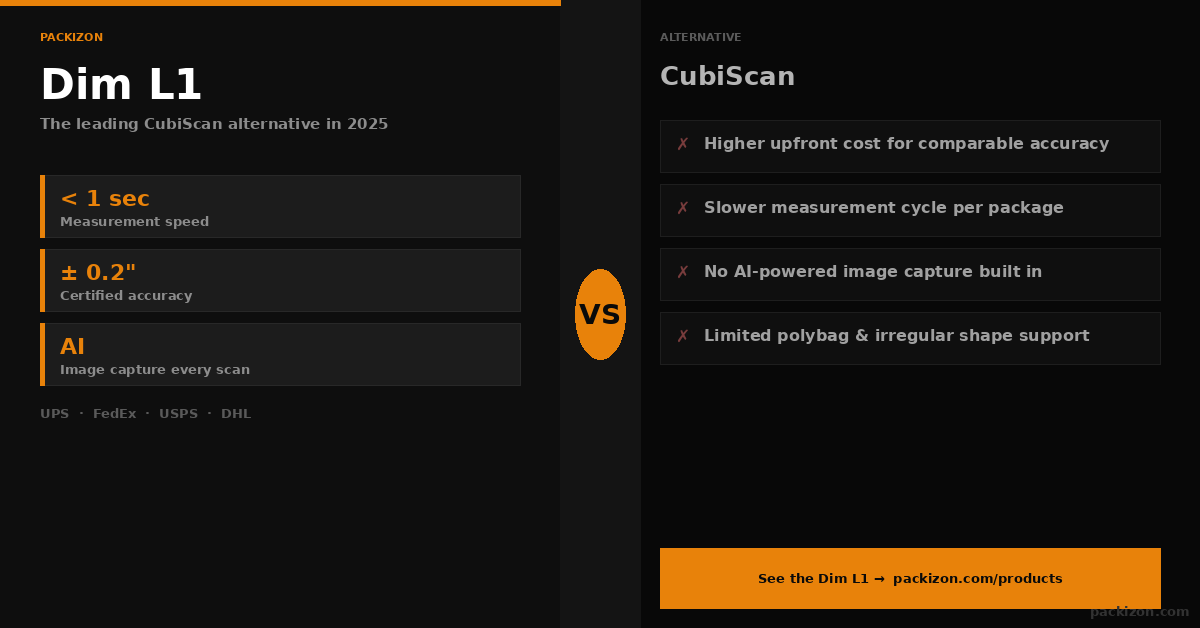
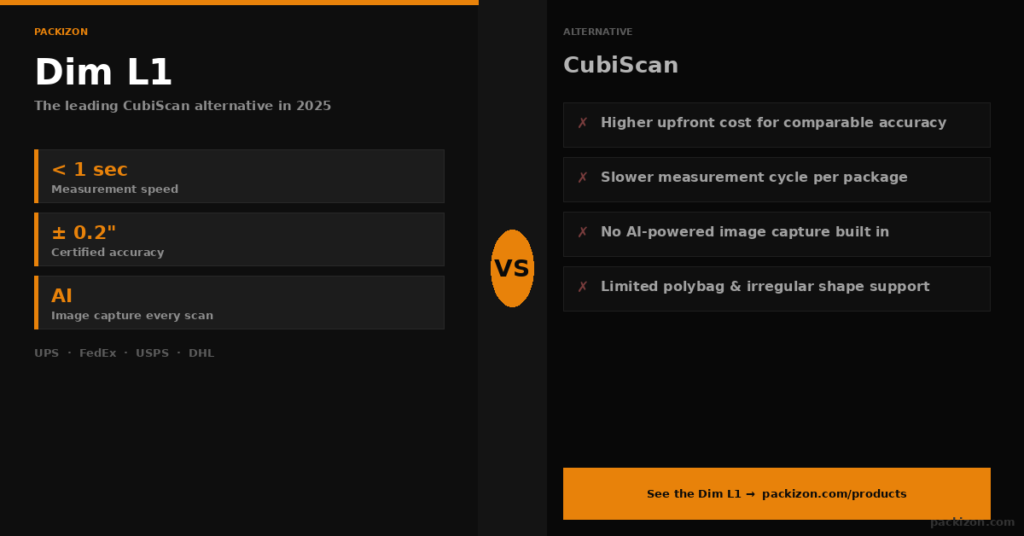
Quick Answer: The best CubiScan alternatives are AI-based dimensioning systems like Packizon Dim L1, FreightSnap FS-5000, and Rice Lake iDimension. Packizon costs 70–80% less than CubiScan, delivers ±5mm / ±0.2 in accuracy, and requires no dedicated hardware frame — making it the leading choice for warehouses needing flexible, budget-friendly dimensioning.
Why Operations Are Looking Beyond CubiScan
CubiScan has been a dominant name in parcel dimensioning for decades, but the market has matured significantly. Buyers are increasingly evaluating alternatives because of changes in their requirements: NTEP certification has become a competitive necessity as carriers audit more aggressively, AI-based measurement has raised accuracy expectations for irregular packages, and integration requirements have shifted toward cloud-first platforms and modern APIs rather than legacy serial connections.
The most important shift driving alternative consideration is NTEP certification. CubiScan offers a range of models, but the certification covers specific configurations. Buyers who are comparing systems need to verify NTEP status at the specific model and configuration level — not just the brand. Packizon’s platform is consistent across its product line, which simplifies the compliance verification process for operations that need certified measurements for carrier dispute documentation.
Accuracy Comparison: Packizon vs CubiScan
For standard rectangular boxes, CubiScan and Packizon both achieve accuracy within NTEP-required tolerances — typically ±0.2 to ±0.4 inches. The meaningful accuracy differences emerge with non-standard package types: polybags, irregular shapes, and packages with reflective or very dark surfaces. CubiScan’s laser-based systems can struggle with polybag sag and specular reflection on metallic packaging.
Packizon’s AI-powered measurement approach captures a dense point cloud across the full package surface, enabling more consistent results on challenging items. For operations where a significant portion of outbound volume is polybags, irregular items, or soft-sided packaging, the accuracy difference on those specific items is where dimensioning system ROI is won or lost. A single percentage point difference in chargeback rate on 500 daily polybag shipments represents thousands of dollars per month in recovered or lost freight charges.
WMS and Shipping Platform Integration
CubiScan systems use a combination of proprietary software (CubiComm) and RS-232/USB serial output to transmit dimensional data to host systems. Integration with modern cloud-based WMS and shipping platforms often requires middleware or custom development. For operations on newer platforms — ShipBob, ShipStation, EasyPost, or cloud WMS like Deposco or Logiwa — this integration gap is a significant deployment obstacle.
Packizon connects via REST API to major shipping and WMS platforms natively, without requiring middleware. Setup is configuration-based rather than code-based for supported platforms, which means the IT burden of deployment is significantly lower. For 3PLs running multiple client accounts on different platforms, Packizon’s flexible API model supports multi-client, multi-carrier configurations from a single dimensioning installation.
Total Cost of Ownership Comparison
CubiScan’s hardware pricing for certified in-motion systems typically starts at $30,000–$50,000 installed, with ongoing maintenance contracts and software licensing adding 15–20% of hardware cost annually. The total 5-year cost of ownership for a mid-range installation frequently exceeds $80,000–$100,000 when integration development, calibration services, and support are included.
Packizon’s pricing model is competitive on hardware and substantially lower on total ownership cost because native integrations eliminate custom development, and the AI-based measurement approach reduces re-calibration frequency. For operations evaluating capital expenditure over a 3–5 year horizon, the comparison should be made on total cost including integration, support, and ongoing maintenance — not hardware sticker price alone.
Which Operations Should Consider a CubiScan Alternative
Operations with high polybag and irregular-shape volume, cloud-first technology stacks, or requirements for built-in carrier dispute documentation are strongest candidates for evaluating Packizon as a CubiScan alternative. 3PLs managing multiple client accounts benefit particularly from Packizon’s multi-client data separation and reporting, which is designed for shared-facility environments where each client’s measurement data must be tracked and billed separately.
Operations with very high throughput requirements on uniform rectangular box conveyors where a proven, widely-serviced system is prioritized may find CubiScan’s market maturity an advantage. The right decision depends on your specific package mix, technology stack, throughput requirements, and the importance of irregular-shape accuracy and carrier dispute documentation in your freight cost management strategy.
Frequently Asked Questions
Why are warehouses looking for CubiScan alternatives?
CubiScan systems cost $15,000–$40,000 per unit, require dedicated installation space, and need specialist calibration servicing. Many warehouses are switching to AI-based alternatives that deliver high-accuracy measurement at 70–80% lower cost with no fixed infrastructure requirements.
What is the most accurate CubiScan alternative?
Packizon Dim L1 delivers ±5mm / ±0.2 in accuracy using edge AI computer vision — at a fraction of CubiScan’s cost and with no fixed hardware frame. It captures a timestamped package image with every scan, and processes measurements in under one second — the same performance benchmark as CubiScan 325.
Can I use a CubiScan alternative for carrier dispute evidence?
Yes — any accurate dimensioning system produces measurement records that carriers accept for billing disputes. Packizon Dim L1 generates a timestamped measurement file with timestamp and package image, which UPS, FedEx, and USPS accept as dispute evidence.
Does a CubiScan alternative integrate with WMS software?
Packizon Dim L1 integrates via REST API with all major WMS platforms including Manhattan Associates, Blue Yonder, Körber, Extensiv, and Deposco. It also supports CSV export and SFTP for legacy systems. API integration typically takes 1–5 business days.
What is the difference between CubiScan and AI dimensioning?
CubiScan uses a physical measurement frame with laser curtains or contact sensors to capture dimensions. AI dimensioning systems like Packizon use depth cameras and computer vision models. AI systems handle irregular shapes better, cost less, and require no hardware frame — but both achieve equivalent accuracy for standard parcel shapes.