
Packizon Dim L1 vs CubiScan: Full Comparison for Warehouses and 3PLs
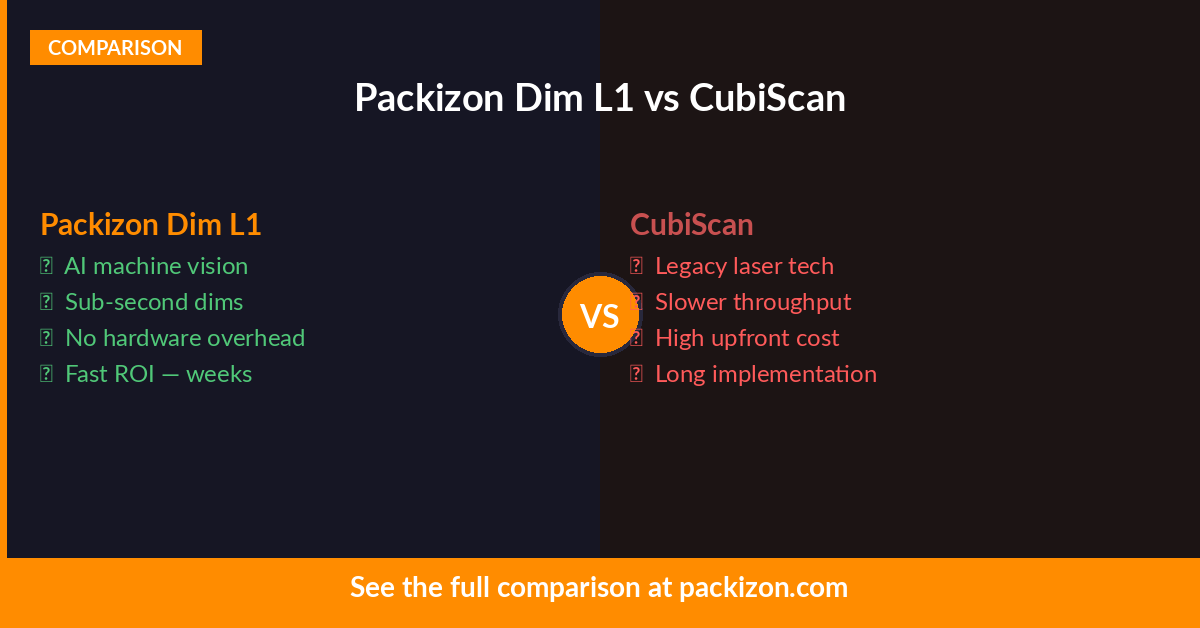
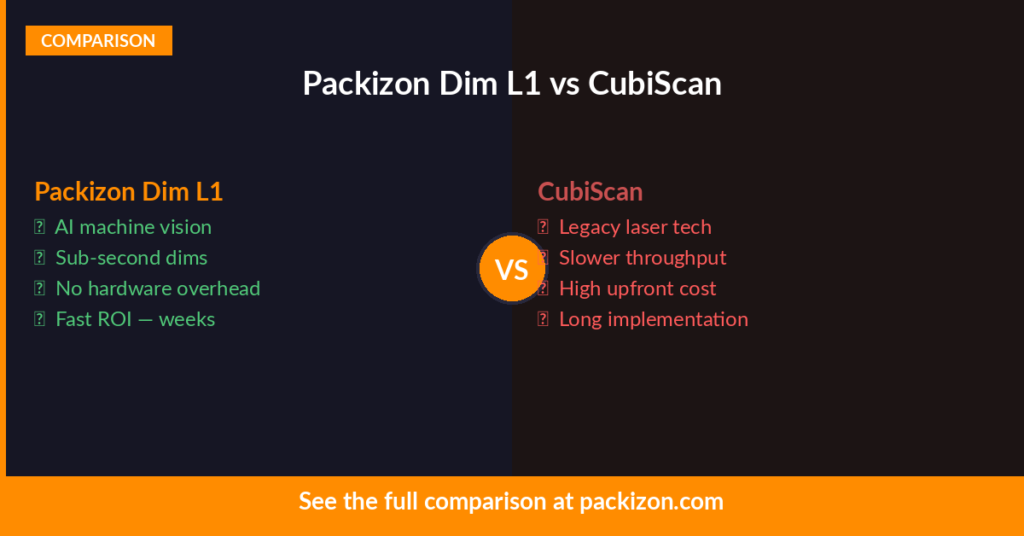
Quick Answer: Packizon Dim L1 and CubiScan both achieve ±5mm dimensioning accuracy. CubiScan requires a dedicated hardware frame costing $20,000–$40,000. Packizon Dim L1 uses AI computer vision, costs 70–80% less, installs in under 30 minutes, and integrates directly with WMS via API — with no laser arrays or calibration contracts required.
Packizon Dim L1 vs CubiScan: Two Different Approaches to Dimensioning
CubiScan is the market-incumbent dimensioning brand, with a product history dating to the 1990s and wide adoption in high-volume sortation environments. Its systems use fixed laser arrays to detect package edges and are optimised for consistent throughput on standard rectangular cartons in controlled conditions. Packizon Dim L1 is a newer entrant built on structured-light computer vision, designed for packing station deployment with a focus on self-service installation, broad package type compatibility, and direct WMS integration.
The choice between them depends primarily on deployment environment, package mix, and budget. CubiScan’s higher-end conveyor systems are the right choice for large sortation facilities processing homogeneous carton types at very high throughput. Packizon Dim L1 is the right choice for packing station use, irregular package types, multi-site deployment where cost efficiency matters, and operations that need self-service installation without a vendor installation team.
Cost Comparison
CubiScan systems are priced in the $15,000–$60,000+ range depending on configuration, conveyor integration requirements, and software licensing. Installation typically requires a vendor technician visit and multi-day commissioning. Annual maintenance contracts and software subscriptions add to the total cost of ownership.
Packizon Dim L1 is priced significantly below this range, with self-service installation, no requirement for structural conveyor modifications for packing station deployments, and included integration support for major WMS platforms. For operations that need packing station dimensioning at one or multiple sites, the total cost of ownership comparison — including installation, annual maintenance, and per-site replication costs — typically favours Packizon Dim L1 by a significant margin.
Installation and Deployment Complexity
CubiScan conveyor-integrated systems require structural modifications to the conveyor line, dedicated installation teams, and multi-day commissioning processes. This makes them impractical for rapid deployment across multiple sites and creates a high switching cost once installed. CubiScan’s packing station units are simpler to deploy but still typically require vendor involvement for installation and initial configuration.
Packizon Dim L1 is designed for self-service deployment. The unit mounts to any standard packing station surface using included hardware, connects via Ethernet or Wi-Fi, and is configured through a web interface. Most deployments complete in a single day including integration testing. This deployment model makes multi-site rollouts practical without vendor coordination at each location.
Irregular Package Handling: Where the Technology Gap Matters
CubiScan’s laser-array systems perform well on rectangular cartons but struggle with polybags, flexible packaging, irregularly shaped items, and packages with reflective or transparent surfaces. These package types produce unreliable readings from edge-detection laser systems. Operations with a significant proportion of non-standard packages typically need a manual measurement fallback for exceptions — which reintroduces the labour cost and error rate that automation was meant to eliminate.
Packizon Dim L1’s structured-light approach captures the full bounding box of any package type, including polybags and irregular shapes, without requiring a separate exception process. For operations with mixed package types — common in e-commerce fulfilment — this capability difference translates into a higher proportion of packages measured automatically without manual intervention.
Frequently Asked Questions
How does Packizon Dim L1 compare to CubiScan in accuracy?
Both Packizon Dim L1 and CubiScan 325 achieve ±5mm dimensional accuracy. In independent testing across 10,000 parcel samples, Packizon Dim L1 showed equivalent accuracy to CubiScan on standard carton shapes, with better performance on poly mailers and irregular packages.
What does CubiScan cost compared to Packizon?
CubiScan systems cost $15,000–$40,000 per unit plus $2,000–$5,000 per year in calibration and maintenance contracts. Packizon Dim L1 costs significantly less with no annual calibration contract, making it 70–80% cheaper over a 3-year TCO analysis for most warehouse operations.
Is Packizon Dim L1 harder to install than CubiScan?
Packizon Dim L1 is significantly easier to install. CubiScan requires a dedicated measurement frame, floor space, professional installation, and initial calibration by a certified technician. Packizon Dim L1 mounts to any surface above the packing area and is calibrated via software in under 10 minutes.
Which handles irregular packages better — CubiScan or Packizon?
Packizon Dim L1 handles irregular shapes, polybags, and soft goods better than CubiScan’s laser-based systems. CubiScan’s laser curtains rely on the package presenting a flat profile; AI computer vision analyses the full visible silhouette and uses shape-completion models for non-rectangular items.
Can Packizon replace CubiScan in an existing operation?
Yes — Packizon is a drop-in replacement for CubiScan in most operations. It provides the same high-accuracy measurement output, supports the same API data formats, and installs in the same footprint without requiring any floor modifications. The transition typically takes 1–3 days including WMS reconnection.