Dimensioning Solutions

Explore how Packizon’s advanced dimensioning solutions help logistics companies automate measurements, reduce errors, and optimize warehouse operations.

Warehouse dimensioning solutions for distribution centre operations

Package Dimensioning for Food and Beverage Distribution

Quick Answer: Food and beverage distribution requires dimensioning systems that handle variable packaging formats — cases, bags, bottles, bundles — at high throughput. AI-based dimensioning captures certified L×W×H for each SKU format, enabling accurate freight class billing, cartonization, and carrier chargeback defence in a sector where packaging changes frequently. Why Package Dimensioning Matters in Food […]

Package Dimensioning for Food and Beverage Distribution Read More »

Parcel dimensioning technology measuring package length width and height accurately

Package Dimensioning for Pharmaceutical and Healthcare Shipping

Quick Answer: Pharmaceutical package dimensioning must meet stricter accuracy requirements than standard parcel operations because pharmaceutical items are often high-value, regulated, and subject to carrier and customs inspection. NTEP-certified dimensioning with image capture provides the certified measurement records required for pharmaceutical logistics compliance and carrier dispute resolution. The Role of Package Dimensioning in Pharmaceutical Distribution

Package Dimensioning for Pharmaceutical and Healthcare Shipping Read More »

Complete guide to dimensioning systems for warehouse and logistics operations

How to Make the Business Case for a Dimensioning System

Quick Answer: To build a business case for a dimensioning system, quantify three ROI streams: carrier DIM weight [UPS DIM weight] adjustment recovery (typically $50,000–$200,000/year), carton optimisation savings (10–20% shipping cost reduction), and labour elimination ($20,000–$60,000/year in manual measurement time). Sum these against system cost for payback period — usually 3–9 months. Why Dimensioning Systems

How to Make the Business Case for a Dimensioning System Read More »

Polybag and flexible packaging being measured by AI dimensioning system

Polybag and Soft Goods Dimensioning: Solving the Hardest Measurement Problem in Warehousing

Quick Answer: Polybag and soft goods dimensioning is one of the hardest measurement problems in warehousing because flexible packaging deforms under compression and changes shape unpredictably. AI computer vision dimensioners solve this by analysing the visible silhouette and using shape-estimation models rather than relying on the package presenting a flat surface to a laser. Why

Polybag and Soft Goods Dimensioning: Solving the Hardest Measurement Problem in Warehousing Read More »

Warehouse dimensioning solutions for distribution centre operations

Dimensioning Systems for Retail Distribution Centres

Quick Answer: Retail distribution centres need dimensioning systems that can update item master data at receiving speed, handle both case-level and pallet-level measurements, and integrate with WMS slotting and cartonization modules. AI-based dimensioning at receiving docks captures certified dimensions for every new SKU arrival, enabling accurate bin slotting, DIM billing, and stock replenishment from day

Dimensioning Systems for Retail Distribution Centres Read More »

Parcel dimensioning technology measuring package length width and height accurately

What Is NTEP Certification for Dimensioning Systems?

Quick Answer: NTEP certification for dimensioning systems means the device has passed testing by a NCWM-approved laboratory against Handbook 44 accuracy standards (±0.2 inches / ±5mm). NTEP-certified dimensioners produce legal-for-trade measurement records accepted by UPS, FedEx, and USPS as evidence in carrier billing disputes. Understanding NTEP Certification for Dimensioning Systems NTEP — the National Type

What Is NTEP Certification for Dimensioning Systems? Read More »

Dimensioning system ROI calculator showing payback period and cost savings

How Much Does a Dimensioning System Cost?

Quick Answer: Dimensioning systems cost $3,000–$40,000 depending on technology type. AI-based systems like Packizon Dim L1 start at the lower end with no annual calibration contract. Traditional laser systems (CubiScan, FreightSnap) cost $15,000–$40,000 plus $2,000–$5,000/year in maintenance. Most operations achieve payback in 3–9 months through recovered carrier adjustments alone. Dimensioning System Price Ranges by Type

How Much Does a Dimensioning System Cost? Read More »

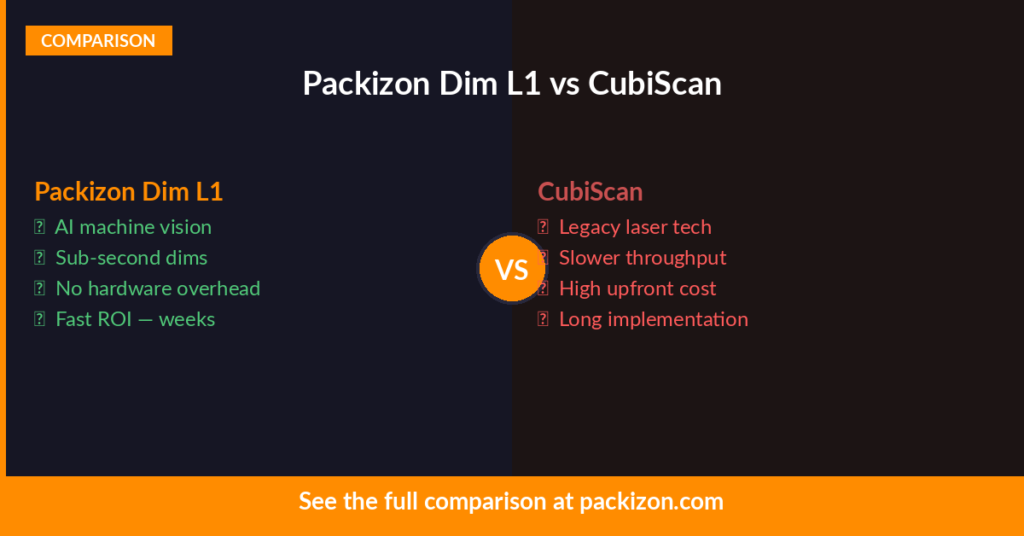
Packizon Dim L1 vs CubiScan dimensioning system side-by-side comparison

What Is the Difference Between CubiScan and AI Dimensioning?

Quick Answer: CubiScan uses laser curtain technology to measure a package’s bounding box and has been the industry standard for fixed-station dimensioning since the 1990s. AI dimensioning systems use computer vision and machine learning to capture dimensions from camera images — enabling handheld, mobile, and AI-powered measurement without dedicated hardware. Packizon is an AI dimensioning

What Is the Difference Between CubiScan and AI Dimensioning? Read More »

In-motion conveyor dimensioning system vs static dimensioning station comparison

Static vs In-Motion Dimensioning: What Is the Difference?

Quick Answer: Static dimensioning requires the package to stop at a fixed measurement station; a scan takes 1–3 seconds. In-motion dimensioning measures packages as they move on a conveyor at full line speed — no stopping required. Choose static for manual packing operations under 600 parcels/hour; choose in-motion for conveyor sortation lines above 600 parcels/hour.

Static vs In-Motion Dimensioning: What Is the Difference? Read More »

📋
Free: 2026 Warehouse Dimensioning Buyer's Checklist 47 criteria to evaluate any system before you sign — used by operations managers & logistics engineers
Download Free PDF →