
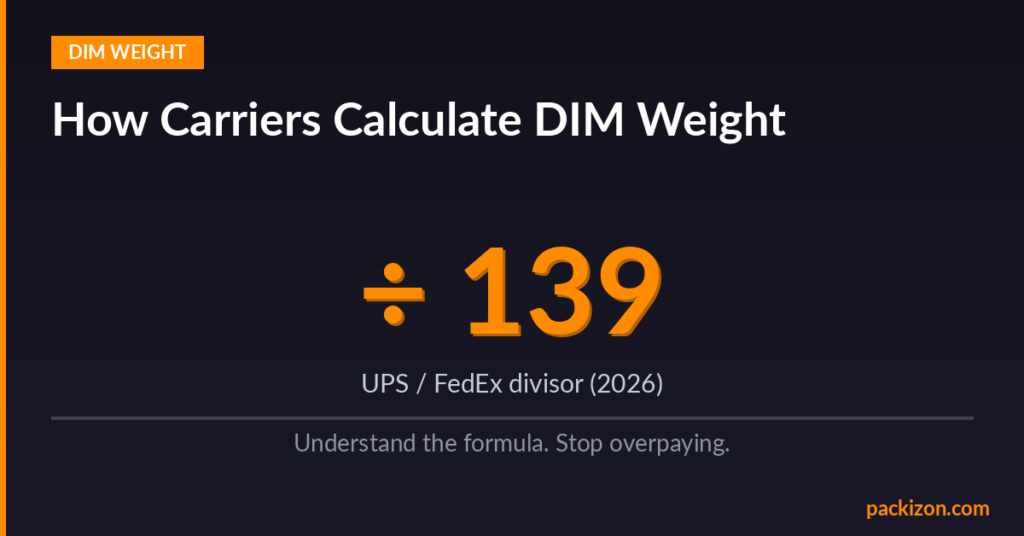
Carrier DIM Weight Divisors: FedEx, UPS, and USPS Explained
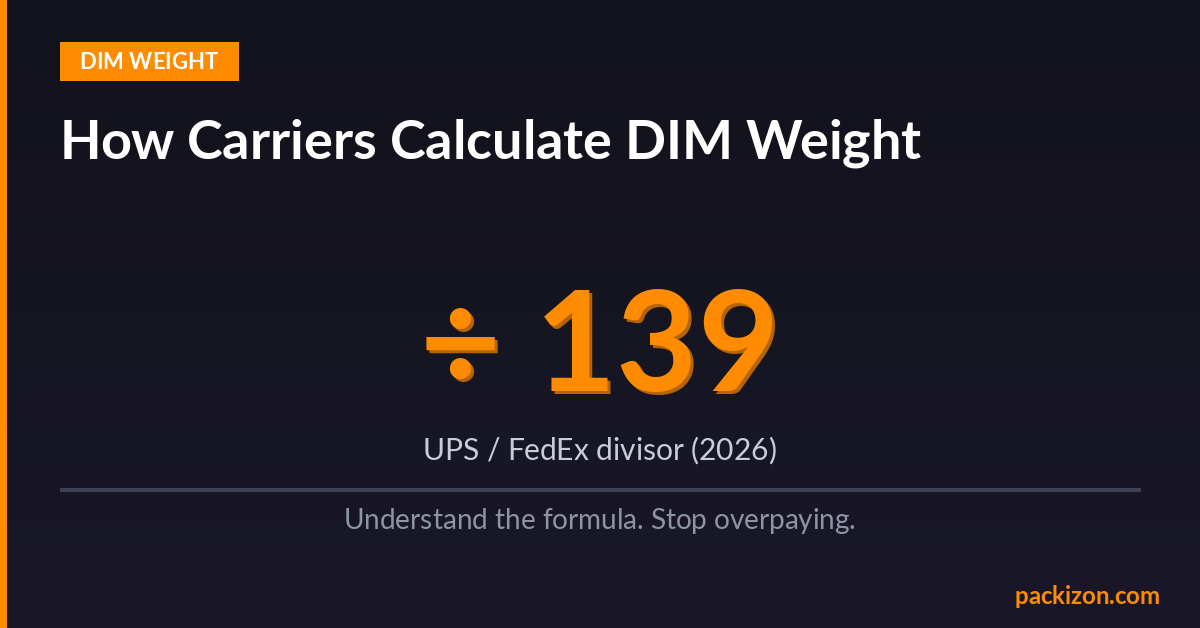
Quick Answer: FedEx and UPS both use a DIM divisor of 139 for domestic US shipments. USPS uses 166 for Priority Mail packages over 1 cubic foot. For international shipments, UPS uses 139 and FedEx varies by service. A higher DIM divisor means lower DIM weight billing — high-volume shippers can often negotiate custom divisors above the standard 139.
What Is a DIM Weight Divisor?
A DIM weight divisor is the number carriers use to convert a package’s cubic size into a billable weight. The formula is straightforward: multiply length by width by height (all in inches), then divide by the DIM divisor. If the resulting dimensional weight exceeds the actual scale weight, the carrier charges the higher figure.
The divisor was introduced by major carriers in the early 2000s to account for the growing volume of lightweight but large packages — especially from e-commerce — that take up more space in trailers and aircraft than their physical weight would suggest. Today, DIM weight pricing applies to virtually every domestic parcel shipment regardless of carrier.
Current DIM Divisors by Carrier (2025–2026)
FedEx and UPS both use a standard DIM divisor of 139 for domestic US shipments. This applies to FedEx Ground, Home Delivery, and Express services, as well as UPS Ground, 2nd Day Air, and Next Day Air. To calculate DIM weight: (L × W × H) ÷ 139. A package measuring 18 × 14 × 12 inches has a cubic volume of 3,024 cubic inches. Divide by 139 and you get a DIM weight of approximately 21.8 lbs — rounded up to 22 lbs.
USPS applies DIM weight only to Priority Mail and Priority Mail Express packages exceeding one cubic foot (1,728 cubic inches). Their standard divisor is 166, which is more lenient than FedEx or UPS. First-Class Mail and Parcel Select are not subject to DIM weight pricing at all, making USPS comparatively advantageous for certain small parcel profiles.
For international shipments, both FedEx and UPS typically use a divisor of 139 (US customary) or 5,000 (metric, using centimeters). Always confirm the applicable divisor for your specific service and lane before quoting shipping costs.
How Inaccurate Dimensions Drive Up Your Carrier Bill
Even small measurement errors compound dramatically at scale. If a product measured manually is recorded as 12 × 10 × 8 inches when it actually measures 13 × 11 × 9 inches, the DIM weight jumps from 6.9 lbs to 9.3 lbs — a 35% increase. Multiply that by hundreds of thousands of shipments per year and the billing gap becomes substantial.
Carriers also conduct audits and re-weigh packages at their facilities. When they find dimensional discrepancies versus what was declared at the time of shipment, they issue post-shipment billing adjustments (chargebacks). These corrections can arrive weeks after delivery, making them difficult to dispute and hard to budget for. Shippers with inaccurate item master data in their WMS are particularly exposed to this risk.
Automated dimensioning systems like the Packizon Dim L1 capture certified length, width, and height measurements at the point of packing — typically in under two seconds per package. Accurate dimensions flow directly into your WMS or shipping software, ensuring the DIM weight declared to the carrier matches what is actually inside the box before it ever leaves the dock.
Negotiating a Custom DIM Divisor
High-volume shippers — typically those spending $1 million or more annually with a single carrier — may be able to negotiate a custom DIM divisor above the standard 139. A negotiated divisor of 166 or 194 means more of your packages will be billed on actual weight rather than dimensional weight, directly reducing your per-shipment cost.
To build a compelling case for negotiation, you need reliable data: average package dimensions across your SKU mix, the proportion of shipments where DIM weight exceeds actual weight, and the total annual spend at the current divisor versus the projected spend at the proposed divisor. Carriers respond to evidence, and automated dimensioning data provides exactly that — a defensible, certified record of your actual package sizes rather than estimates from a spreadsheet.
Why Certified Dimensions Matter for Carrier Compliance
Both FedEx and UPS reserve the right to re-measure any package at their facilities. If their measurement differs from yours by more than a defined threshold, they bill the higher weight — and often add a correction fee on top. NTEP-certified dimensioning equipment provides a legal standard of measurement that creates a defensible record if you choose to dispute a carrier correction.
The Packizon Dim L1 is high-accuracy and produces time-stamped dimension records for every package measured. When a carrier issues a chargeback, you can cross-reference the shipment tracking number against your dimensioning log to verify whether the correction is legitimate or an error. Over time, this audit trail also helps identify which SKUs or package types are most frequently flagged, allowing you to adjust your cartonization or packing processes proactively.
Frequently Asked Questions
What DIM divisor does FedEx use?
FedEx uses a DIM divisor of 139 [FedEx rate guide] for domestic US Ground, Home Delivery, and Express shipments. The DIM weight formula is: (L × W × H in inches) ÷ 139, rounded up to the next whole pound. For FedEx International Priority, the divisor is 139 as well. FedEx One Rate and flat-rate packaging options bypass DIM weight entirely.
What DIM divisor does UPS use?
UPS uses a DIM divisor of 139 [UPS DIM pricing] for all domestic US services including Ground, 2nd Day Air, and Next Day Air. The formula is identical to FedEx: (L × W × H in inches) ÷ 139. UPS Simple Rate packaging options and SurePost for packages under a certain size may bypass DIM weight. International UPS shipments use divisor 139.
What DIM divisor does USPS use?
USPS applies DIM weight only to Priority Mail and Priority Mail Express packages exceeding 1 cubic foot (1,728 cubic inches). The USPS DIM divisor is 166 [USPS DIM weight]. Packages at or below 1 cubic foot are billed on actual weight only. Ground Advantage and First Class Package Service do not use dimensional weight pricing at all.
Can I negotiate a higher DIM divisor with UPS or FedEx?
Yes — carriers offer custom DIM divisors to high-volume shippers, typically those shipping 10,000+ packages per week. A higher divisor (e.g., 166 vs 139) reduces your DIM weight billing proportionally. Negotiating a higher divisor requires demonstrating your package density data — which certified dimensioning measurement records make straightforward.
How do I calculate DIM weight using the standard divisor?
DIM weight = (Length × Width × Height) ÷ 139, where all dimensions are in inches. The result is rounded up to the next whole pound. Example: a 14×10×8-inch box = 1,120 cubic inches ÷ 139 = 8.06, rounded to 9 lbs DIM weight. If actual weight is 6 lbs, you’re billed 9 lbs — paying for 50% more weight than the package actually weighs.
Industry Data
Carrier DIM Weight Divisors: Key Facts
139
DIM divisor for FedEx and UPS domestic U.S. shipments measured in inches
166
USPS Priority Mail DIM divisor â higher divisor means lower DIM charges
5,000
international DIM divisor used by FedEx when dimensions are in centimeters
3-7%
of freight spend recovered annually by correcting DIM weight overcharges
94%
reduction in carrier billing corrections achieved with certified dimensioning