
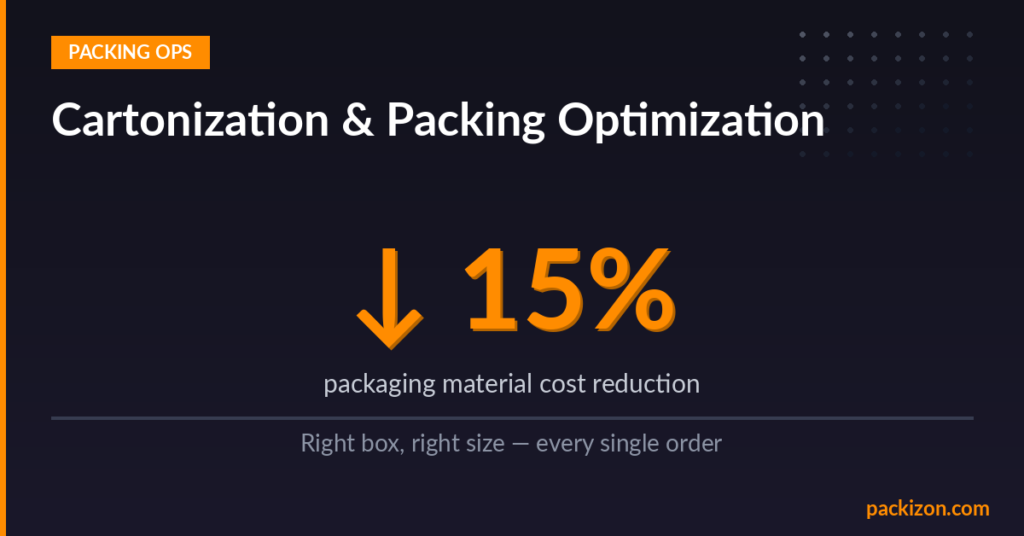
Cartonization and Package Dimensioning: How Accurate Dim Data Improves Packing ROI
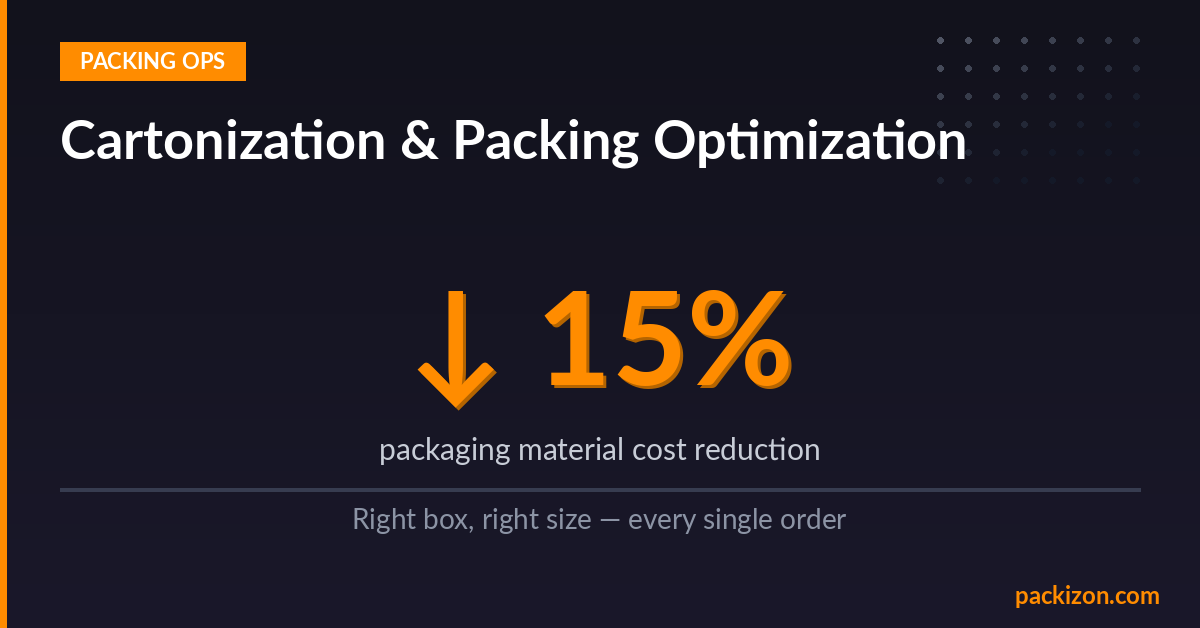
Quick Answer: Cartonization and package dimensioning work together to reduce shipping costs: the dimensioning system provides certified L×W×H for each item in the order, and the cartonization algorithm selects the smallest carton that fits all items. When item master dimensions are accurate, cartonization reduces average DIM weight [FedEx DIM pricing] by 15–25% and eliminates void fill on 20–30% of shipments.
What Is Cartonisation and Why Do Dimensions Matter So Much?
Cartonisation is the process of selecting the optimal carton size for each outbound order based on the dimensions and quantity of the items being packed. The goal is to choose the smallest box that can safely contain the order contents, minimising void fill, DIM weight, and packaging material cost simultaneously. Modern cartonisation software automates this selection at the order level, evaluating available carton options and selecting the best fit for each specific combination of SKUs in an order.
The critical dependency of cartonisation is item master dimension accuracy. Cartonisation algorithms are geometric — they calculate whether a set of item dimensions will fit within a carton’s interior dimensions, accounting for orientation, stacking, and fill percentage. If the stored item dimensions are wrong by even a few millimetres, the algorithm may consistently select boxes that are too small (causing re-packing) or too large (wasting space and increasing DIM weight). Cartonisation is only as good as the dimension data it runs on.
How Accurate Package Dimensioning Improves Cartonisation Results
Research on cartonisation system deployments consistently finds that the largest determinant of cartonisation accuracy is item master data quality rather than algorithm sophistication. An operation with accurate certified dimensions and a basic cartonisation algorithm outperforms one with inaccurate manually-entered dimensions and a sophisticated algorithm, because the algorithm can only optimise what it knows.
Automated dimensioning at the receiving dock provides the clean item master data that cartonisation requires. Every SKU received is measured to ±5mm accuracy, the measurement is transmitted to the WMS [Gartner WMS] item master, and cartonisation calculations from that point forward use certified rather than estimated dimensions. Operations that clean their item master through a systematic dimensioning project at receiving typically see cartonisation accuracy improvements of 15–25% in box utilisation, with corresponding reductions in DIM weight and void fill costs.
Populating WMS Item Master Data with Certified Dimensions
There are two approaches to building an accurate item master: retrospective measurement of the existing catalogue, and prospective measurement of every new SKU at first receipt. Retrospective measurement involves dimensioning all current active SKUs in a focused project — typically taking one to three days for a catalogue of 500–2,000 active SKUs. Prospective measurement integrates the dimensioner into the receiving workflow so that every new SKU is measured automatically as part of the put-away process.
For operations with a large existing catalogue and ongoing new SKU introduction, both approaches are needed: a retrospective project to clean the existing data, followed by prospective measurement to keep it clean as new products arrive. The Packizon Dim L1 supports both workflows — static measurement for retrospective catalogue projects and receiving-dock integration for prospective new SKU capture — from the same unit without reconfiguration.
The ROI of Cartonisation Plus Package Dimensioning
Cartonisation software combined with accurate dimensional data typically delivers shipping cost reductions of 8–18% on DIM weight-affected shipments, through a combination of smaller carton selection (lower DIM weight) and reduced void fill (lower packaging materials cost). The specific reduction depends on how poorly the current carton selection is optimised — operations using a small number of standard carton sizes for a wide range of product sizes tend to see larger improvements than those already using a broader carton range.
The ROI calculation combines the cartonisation savings with the independent benefits of accurate dimensioning: carrier correction reduction, item master accuracy improvements, and labour savings from eliminating manual measurement. Because these savings come from different mechanisms, they are largely additive — which means the combined ROI of cartonisation plus dimensioning typically exceeds either investment in isolation.
Frequently Asked Questions
What is cartonization and how does it use dimensioning data?
Cartonization is the process of selecting the optimal carton (or combination of cartons) to pack a multi-item order, minimising wasted space and carrier DIM weight. The algorithm compares each item’s L×W×H from the WMS item master against available carton sizes, then selects the smallest carton where all items fit. Accurate item master dimensions are the critical input — wrong dimensions produce wrong carton selections.
How much can accurate dimensioning improve cartonization?
Operations that populate their WMS item master with certified measurement data (rather than estimates or vendor-supplied dimensions) typically see 15–25% improvement in cartonization efficiency — measured as reduction in average carton void fill percentage. This translates directly to DIM weight billing savings, as smaller cartons have lower DIM weight.
What is the best way to populate WMS item master data for cartonization?
Measure every inbound SKU on first receipt using a certified dimensioning system, write L×W×H and weight to the WMS item master via API, and trigger a re-measurement whenever a vendor changes packaging. This ensures cartonization always uses measured (not estimated) dimensions. Estimated or vendor-supplied dimensions are frequently wrong by 10–20%, causing cartonization to select over-large cartons.
Does cartonization software work with Packizon package dimensioning?
Yes — Packizon Dim L1’s REST API sends item dimensions directly to your WMS, which then provides the data to your cartonization engine. Packizon is compatible with all major cartonization solutions including Paccurate, nShift (formerly Cubiscan Cartonization), and cartonization modules built into Manhattan Associates, Blue Yonder, and Körber WMS.
What is the ROI of combining cartonization with package dimensioning?
Combined cartonization + dimensioning ROI is typically: 15–25% reduction in carrier DIM charges (from better carton selection) + 60–90% reduction in carrier billing adjustments (from certified measurement) + elimination of void fill purchasing. For a warehouse shipping 1,000 parcels/day, combined annual savings commonly reach $100,000–$400,000 depending on current cartonization and adjustment rates.