
How Carriers Calculate DIM Weight: The Formula, Factors, and Billing Explained
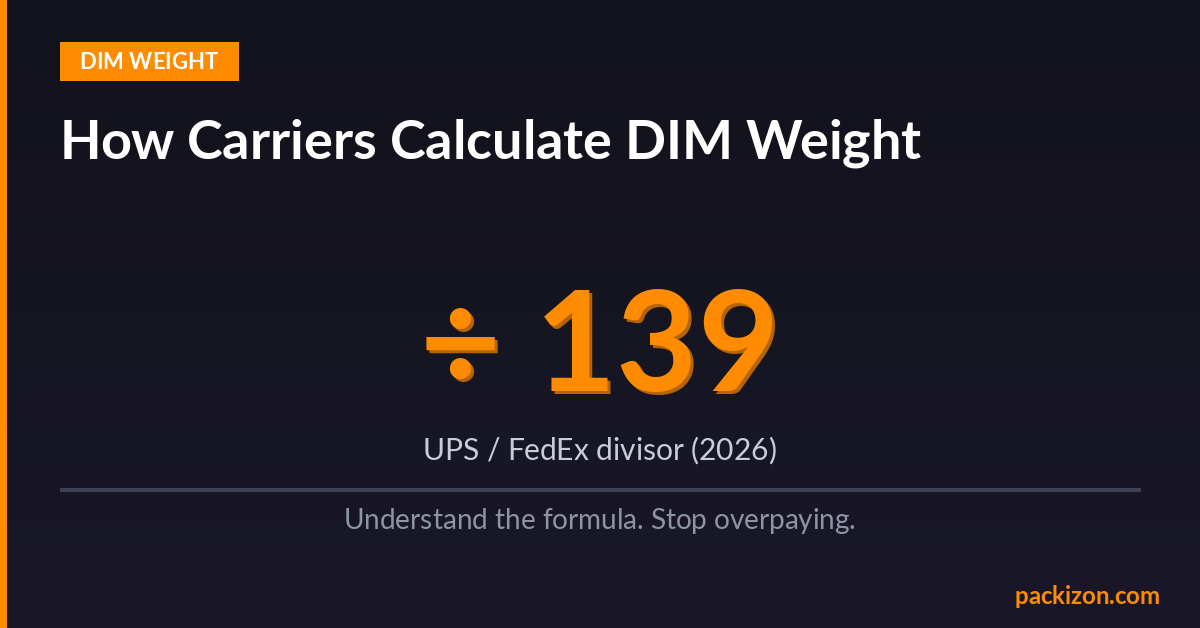
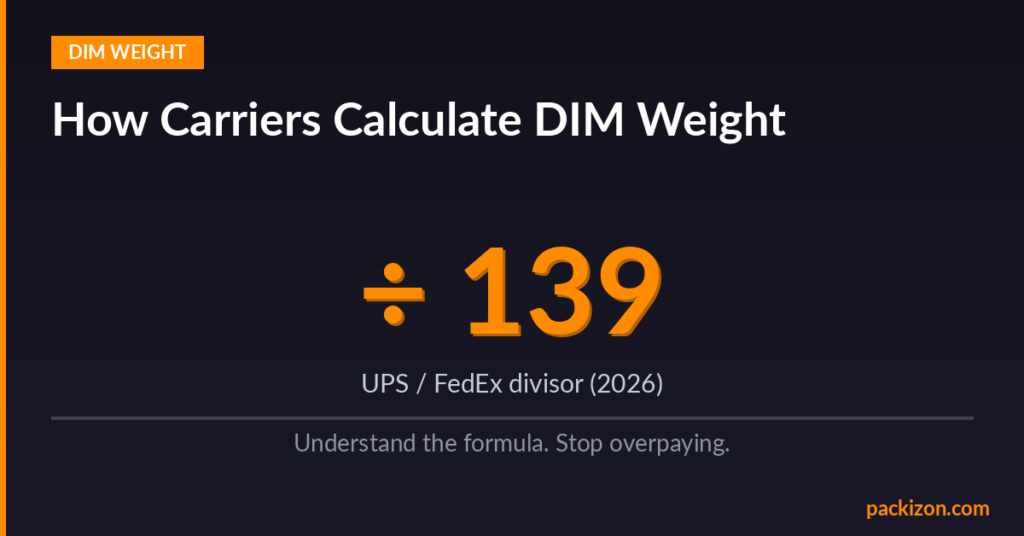
Quick Answer: Carriers calculate DIM weight using the formula: (Length × Width × Height) ÷ DIM divisor. FedEx and UPS use a divisor of 139 [UPS DIM pricing] for domestic US shipments (166 for international). USPS uses 166 for Priority Mail. The resulting DIM weight is compared to actual weight — whichever is higher is the billed weight.
The DIM Weight Formula: How Carriers Convert Size to Billable Weight
Dimensional weight calculation starts with measuring the package in three dimensions: length, width, and height. Multiply these together to get the cubic volume in cubic inches, then divide by the DIM divisor to convert volume to an equivalent weight in pounds. For FedEx and UPS domestic shipments, the standard divisor is 139. The result is rounded up to the nearest whole pound.
Formula: DIM weight (lbs) = (L × W × H) ÷ 139. A package measuring 20 × 16 × 10 inches has a volume of 3,200 cubic inches. Divide by 139 = 23.0 lbs DIM weight. If the actual contents weigh 8 lbs, the carrier bills 23 lbs — nearly three times the physical weight. Every additional inch in any dimension increases the DIM weight, which is why right-sizing cartons has such a direct impact on shipping cost.
Which Dimensions Carriers Use: L×W×H Measurement Rules
FedEx and UPS measure the outermost extent of the package in all three dimensions, including any protruding elements, irregular surfaces, or packaging materials that extend beyond the base carton. For packages with rounded corners or curved surfaces, they measure the widest point in each dimension. This means that a package with bulging sides from overfilling — even if the carton itself is a standard size — will measure larger than the nominal carton dimensions.
For non-rectangular packages (cylinders, triangular prisms, irregular shapes), carriers use the smallest rectangular box that fully encloses the package — the bounding box — for DIM weight calculation. This is the same measurement that a properly configured dimensioning system captures: the minimum enclosing rectangular envelope of the package in all three dimensions, regardless of the actual shape.
When DIM Weight Applies vs When Actual Weight Is Billed
FedEx and UPS apply DIM weight to all domestic parcel shipments regardless of package size — there is no minimum size threshold below which actual weight applies. The billing rule is simple: whichever is higher, DIM weight or actual weight, is the billed weight. For most lightweight e-commerce packages — apparel, electronics accessories, personal care products — DIM weight is almost always higher than actual weight, which means most outbound parcels from e-commerce operations are billed on dimensions rather than the scale reading.
USPS applies DIM weight only to Priority Mail and Priority Mail Express packages exceeding one cubic foot (1,728 cubic inches), using a divisor of 166. First-Class Package Service and Ground Advantage are billed on actual weight only. Regional carriers have varying policies — confirm with your specific regional carrier agreement whether DIM weight applies and at what threshold.
Why Post-Shipment Corrections Happen and How to Prevent Them
Post-shipment billing corrections occur when the carrier’s hub re-measurement produces dimensions different from what was declared at the time of shipment. The carrier’s automated re-weigh systems measure every package passing through major sort facilities. When their reading exceeds declared dimensions by more than a threshold amount, an adjustment is automatically applied — typically at the higher DIM weight they measured, plus sometimes a correction processing fee.
The prevention is straightforward: ensure your declared dimensions are accurate and certified. An high-accuracy dimensioning system at the packing station captures the actual outer dimensions of every package before the label is printed, and those dimensions are transmitted to the shipping software for carrier rating. When carriers re-measure and find the same result, no correction is issued. Operations that deploy certified dimensioning consistently report carrier correction rates falling by 80–95% within the first quarter of operation.
Frequently Asked Questions
What is the DIM weight formula for FedEx and UPS?
FedEx and UPS both use: DIM Weight = (L × W × H) ÷ 139 [FedEx rate guide] for domestic US shipments, where dimensions are in inches and the result is in pounds (round up to the next whole pound). For international shipments, the divisor is 139 for UPS and varies by service for FedEx. USPS uses 166 for Priority Mail packages over 1 cubic foot.
When does DIM weight apply vs actual weight?
Carriers apply DIM weight billing when the calculated DIM weight exceeds the actual (scale) weight. For example: a 12×12×12-inch box weighing 3 lbs has a DIM weight of 12.4 lbs — so the carrier bills 12 lbs (rounded down for FedEx, rounded up for UPS). Actual weight only applies when the package is dense enough that actual weight exceeds DIM weight.
Does USPS charge DIM weight?
USPS charges DIM weight on Priority Mail and Priority Mail Express packages exceeding 1 cubic foot (1,728 cubic inches). The USPS DIM divisor is 166 [USPS DIM weight]. Packages below 1 cubic foot are billed only on actual weight. First Class Package and Ground Advantage services do not use DIM weight pricing.
How do I reduce my DIM weight billing?
The most effective methods are: right-size cartons to minimise empty space (reduces DIM weight 20–40%), use flat-rate boxes for dense items, and deploy a certified dimensioning system to catch discrepancies before shipment. Right-sizing cartons alone reduces average DIM weight billing by $0.50–$1.50 per parcel for typical e-commerce operations.
What is a DIM divisor and can it be negotiated?
The DIM divisor is the number by which the package volume (in cubic inches) is divided to calculate DIM weight in pounds. Standard divisors are 139 (UPS/FedEx domestic) and 166 (USPS/international). High-volume shippers (10,000+ packages/week) can negotiate higher divisors in their carrier contracts, reducing DIM weight billing proportionally.
Industry Data
Carrier DIM Weight Calculation: Key Numbers
139
DIM divisor for FedEx and UPS domestic U.S. packages when measuring in inches
166
DIM divisor for USPS Priority Mail packages over one cubic foot
3-7%
of freight spend lost to DIM weight calculation errors annually
94%
reduction in billing corrections with certified pre-shipment measurement
<1 sec
time for carrier hub dimensioning systems to re-measure every package