
UPS vs FedEx DIM Weight Rules 2026: What’s Changed and How to Avoid Corrections
Understanding the UPS vs FedEx DIM weight rules 2026 is essential for any shipper that wants to control freight costs and avoid unexpected carrier correction charges. Both UPS and FedEx calculate dimensional weight using the same basic formula — length × width × height divided by a DIM factor — but the thresholds, minimum billable weights, and correction policies differ in ways that cost shippers millions of dollars every year. This guide breaks down exactly what the UPS vs FedEx DIM weight rules 2026 require, what has changed, and how NTEP-certified dimensioning technology eliminates the measurement discrepancies that trigger most corrections.
UPS vs FedEx DIM Weight Rules 2026: The Core Formulas
The UPS vs FedEx DIM weight rules 2026 share the same dimensional weight formula but apply it with slightly different parameters depending on service type and destination.
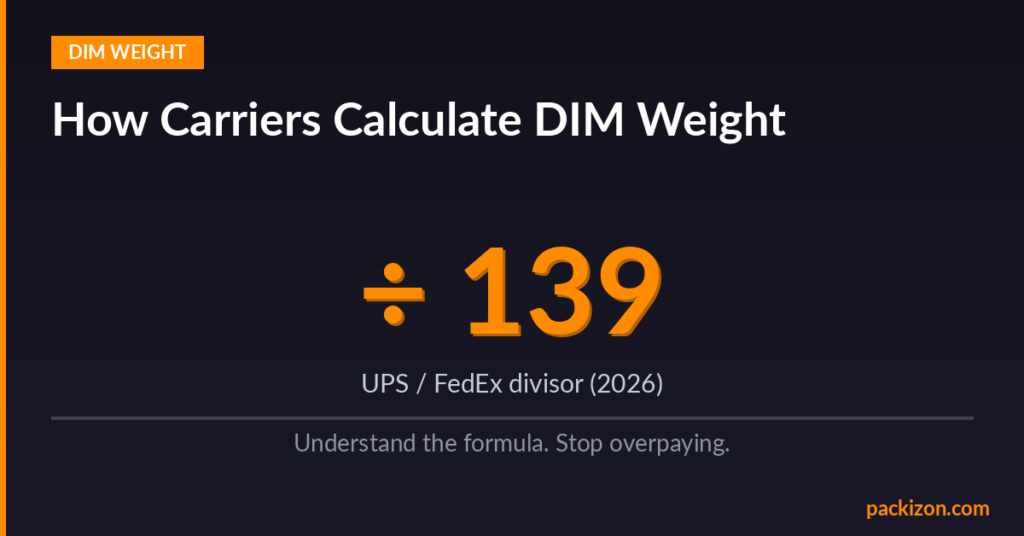
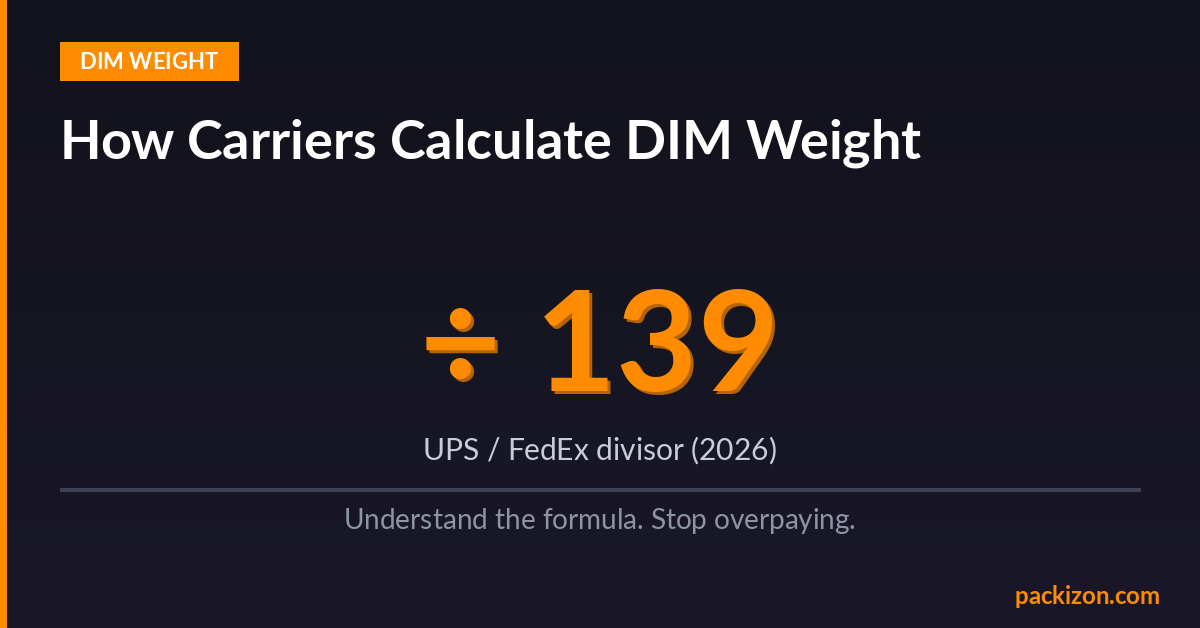
UPS DIM weight formula (domestic): Dimensional weight = (Length × Width × Height) ÷ 139. UPS rounds each package dimension up to the nearest whole inch before applying the formula. The carrier then bills whichever is greater — actual weight or DIM weight — with a minimum billable weight of 1 lb for most services. For international shipments, UPS uses a DIM divisor of 139 for UPS Worldwide Express services billed in pounds, and 5,000 for services billed in kilograms.
FedEx DIM weight formula (domestic): Dimensional weight = (Length × Width × Height) ÷ 139. FedEx also rounds each dimension up to the nearest whole inch. Like UPS, FedEx bills the greater of actual or DIM weight. FedEx applies DIM weight to all domestic packages exceeding 1 cubic foot (1,728 cubic inches) for FedEx Ground and FedEx Home Delivery, and to all packages regardless of size for FedEx Express services.
The critical difference in the UPS vs FedEx DIM weight rules 2026 is in how each carrier’s scanners capture dimensions at induction and how aggressively each applies correction charges when shipper-declared dimensions don’t match scanner readings.
What’s New in UPS vs FedEx DIM Weight Rules for 2026
Both carriers have tightened enforcement of their DIM weight policies in recent years, and 2026 continues that trend. Here is what shippers need to know about the updated UPS vs FedEx DIM weight rules 2026:
UPS 2026 updates: UPS has continued expanding its automated package measurement infrastructure across major hub facilities. Packages that pass through UPS hubs with 3D scan tunnels are automatically re-measured, and any discrepancy between the declared dimensions and the scanned dimensions triggers an address correction or dimensional weight correction charge. UPS published its current DIM weight policies in its UPS rate and service guide, which shippers should review annually as peak-season surcharges can change minimum billable weight thresholds for specific service levels.
FedEx 2026 updates: FedEx has similarly expanded automated measurement at sortation facilities. FedEx Express now applies DIM weight to every package regardless of cubic inches, while FedEx Ground retains the 1,728 cubic inch threshold. FedEx also applies additional handling surcharges to packages whose longest dimension exceeds 48 inches, whose second-longest dimension exceeds 30 inches, or whose actual weight exceeds 50 lbs — charges that compound with DIM weight corrections.
What both carriers have in common in 2026: Neither UPS nor FedEx requires shippers to contest correction charges proactively — if you don’t dispute a correction within the carrier’s published timeframe (typically 30 days for UPS, 21 days for FedEx), the charge stands. This makes measurement accuracy at the point of label creation the only reliable defense.
How Carriers Apply UPS vs FedEx DIM Weight Corrections in Practice
Understanding how the UPS vs FedEx DIM weight rules 2026 translate into real correction charges requires knowing what happens between label creation and billing.
When a shipper generates a label, they declare package dimensions. Those dimensions determine the billed DIM weight at the time of label creation. As the package moves through the carrier network, automated scan tunnels capture actual dimensions using 3D cameras and laser arrays. If the scanned dimensions produce a DIM weight higher than the declared DIM weight — even by a fraction — the carrier issues a correction charge on the final invoice.
Common triggers for correction charges under the UPS vs FedEx DIM weight rules 2026 include:
- Rounding dimensions down instead of up at label creation
- Using nominal box dimensions (the printed size on the box) rather than actual measured dimensions
- Failing to account for protruding handles, irregular shapes, or packaging materials that add to overall dimensions
- Data entry errors where length and width are transposed
- Using outdated box specifications that have expanded due to use or humidity
Industry data suggests that 5–12% of packages receive at least one correction charge from UPS or FedEx, with average correction amounts ranging from $2 to $6 per package. For a shipper moving 10,000 packages per month at an 8% correction rate and $3.20 average correction, that is $25,600 per month in avoidable charges.
UPS vs FedEx DIM Weight Rules 2026: Side-by-Side Comparison
The table below summarizes the key parameters of the UPS vs FedEx DIM weight rules 2026 for domestic parcel shipments:
| Parameter | UPS (2026) | FedEx (2026) |
|---|---|---|
| DIM divisor (domestic, lbs) | 139 | 139 |
| Rounding rule | Round up to nearest inch | Round up to nearest inch |
| Ground threshold | All packages | Packages > 1,728 cu in |
| Express threshold | All packages | All packages |
| Minimum billable weight | 1 lb | 1 lb |
| Correction dispute window | ~30 days | ~21 days |
| Additional handling trigger (longest side) | > 96 inches | > 48 inches |
| Large package surcharge trigger | Girth + length > 130″ | Girth + length > 165″ |
Note that FedEx’s additional handling surcharge triggers at a shorter dimension (48″) than UPS’s (96″), which means FedEx shippers with longer packages face more compound surcharges under the UPS vs FedEx DIM weight rules 2026.
How to Eliminate UPS and FedEx DIM Weight Correction Charges
The most effective way to protect your shipping budget from correction charges under the UPS vs FedEx DIM weight rules 2026 is to ensure that every package is measured accurately — to the exact dimensions the carrier’s scan tunnels will record — before the label is generated.
NTEP-certified dimensioning systems are the gold standard for this. NTEP (National Type Evaluation Program) certification means the dimensioner’s measurements have been tested and approved by the National Conference on Weights and Measures — the same standards body whose certifications UPS and FedEx recognize for disputing correction charges.
The Packizon Dim L1 dimensioner captures certified length, width, height, and weight in under 100 milliseconds at rates up to 60 packages per minute. Each measurement is NTEP-certified and time-stamped, creating an audit trail that can be used to dispute incorrect corrections from either UPS or FedEx. In practice, operations using Packizon eliminate 80–95% of DIM weight correction charges because their declared dimensions match what carrier scan tunnels record.
Beyond the dimensioner, here are additional steps to align with the UPS vs FedEx DIM weight rules 2026:
- Measure every package individually — never rely on nominal box sizes, especially for boxes that have been reused or stored
- Integrate dimension data directly into your shipping platform — manual re-entry is a major source of errors
- Review correction charge reports monthly — patterns in corrections reveal packaging or process problems
- Train staff on rounding rules — both UPS and FedEx round up, so 10.1 inches is billed as 11 inches
- Check for compound surcharges — a package that triggers both a DIM correction and an additional handling surcharge can cost significantly more than either charge alone
UPS vs FedEx DIM Weight Rules 2026: Frequently Asked Questions
Do UPS and FedEx use the same DIM divisor in 2026?
Yes — both carriers use a DIM divisor of 139 for domestic US parcel shipments billed in pounds. The formulas are identical; the differences lie in surcharge triggers, correction dispute windows, and how aggressively each carrier scans packages at sortation.
Which carrier is more aggressive with DIM weight correction charges?
Both carriers have automated measurement infrastructure, so neither is categorically more lenient. However, FedEx’s additional handling surcharge triggers at a shorter dimension (48″ vs UPS’s 96″), which means shippers with longer parcels tend to see more compound charges from FedEx. For standard parcel sizes, correction rates are similar between the two carriers.
Can I dispute UPS or FedEx DIM weight corrections?
Yes, but you must dispute within the carrier’s timeframe (approximately 30 days for UPS, 21 days for FedEx) and provide evidence that your declared dimensions were accurate. high-accuracy measurement records — with timestamps that pre-date the correction notice — are the strongest evidence for successful disputes.
Does DIM weight apply to all FedEx Ground packages in 2026?
No — FedEx Ground and FedEx Home Delivery still apply DIM weight only to packages exceeding 1,728 cubic inches (approximately a 12″ × 12″ × 12″ box). FedEx Express, however, applies DIM weight to all packages regardless of size. UPS applies DIM weight to all packages regardless of size for both Ground and Air services.
How much can accurate dimensioning save on correction charges?
Operations using NTEP-certified dimensioners like the Packizon Dim L1 typically eliminate 80–95% of DIM weight correction charges. For a shipper with 10,000 monthly packages at an 8% correction rate and $3.20 average charge, that represents potential savings of $23,000–$29,000 per month — or $276,000–$349,000 annually.
Industry Data
UPS vs FedEx DIM Weight 2026: Key Facts
139
DIM divisor used by both FedEx and UPS for domestic U.S. shipments in 2026
94%
reduction in carrier billing corrections achieved with certified dimensioning systems
$1-5
typical correction surcharge per package from carrier re-measurement events
3-7%
of freight spend lost annually to DIM weight overcharges without accurate measurement
<1 sec
time for certified dimensioning system to measure and declare DIM weight per package